The Danish population assesses its health as having worsened
Danes rate their health as worse than 15 years ago. Across all age groups from 16 to 64, Danes assess their health as poorer in 2025 than in 2010. Only those aged 75+ assess their health as significantly better than 15 years ago (see Figure 1).
Figure 1
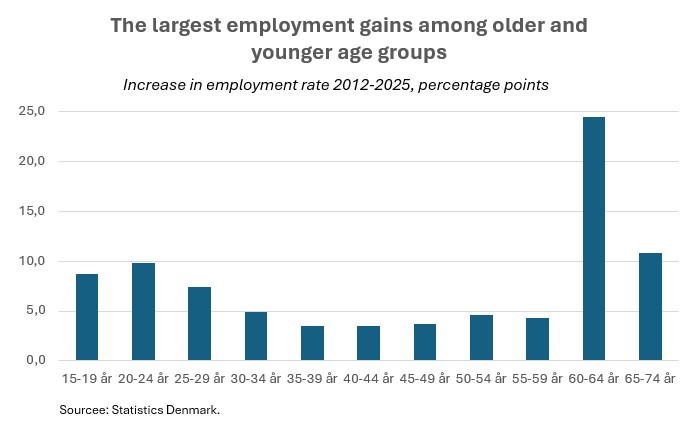
Few people aged 75+ are in employment, which means the trend in self-assessed health is negative for businesses.
Men in all age groups rate their health better than women. For example, 84.3% of men aged 45–54 report having excellent, very good, or good health. The corresponding figure for women is 79.2% (see Figure 2).
Figure 2
The lower self-assessed health among women is striking—especially among those aged 75+—given that women have an average life expectancy that is 3.6 years longer than men.
Physical health unchanged, mental health has worsened
Physical health has remained largely unchanged over the past 15 years. Only among those aged 75+ has the share with a low score on the physical health scale declined significantly—from 35.8% in 2020 to 26.9% in 2025.
By contrast, the share with a low score on the mental health scale has increased markedly from 10% in 2010 to 16% in 2025. This deterioration is particularly evident among younger age groups. The proportion of 16–24-year-olds with a low mental health score has doubled from 2010 to 2025 (see Table 1).
Table 1
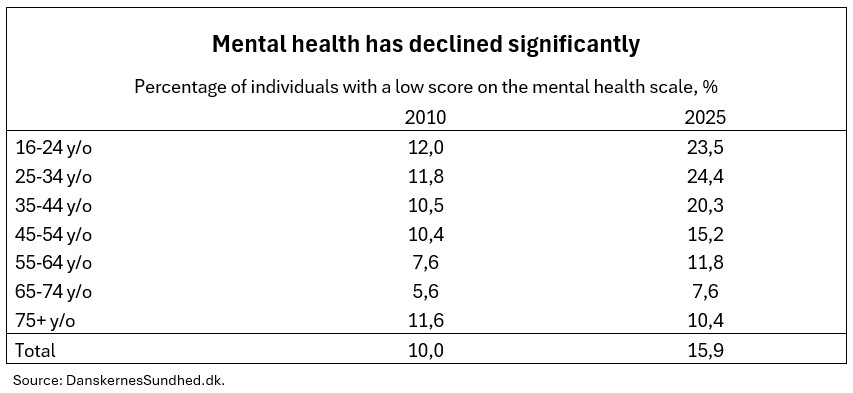
The low mental health score among young people is especially pronounced for women. 31% of all women aged 16–24 have a low mental health score, compared with around 16% for men. The gender gap narrows with age, although it persists across all age groups.
One factor behind poor mental health may be loneliness. Signs of loneliness are most widespread among young people and, for most age groups, occur more frequently among women than men.
Far fewer daily smokers
The share of daily smokers has halved over 15 years, with significant declines across all age groups. The largest drop has occurred among 16–24-year-olds. In 2010, 17.5% of this group smoked daily; in 2025, the figure is 4.6%. Among 16–24-year-olds and 25–34-year-olds, the decline in tobacco smoking has been replaced by e-cigarettes or smokeless nicotine products (see Figure 3).
Figure 3
For all age groups above 35, there have been substantial declines over 15 years in the share of daily users of tobacco or nicotine products. These figures are confirmed by the fact that cigarette sales fell by 9 percent from 2023 to 2024.
Former smokers have a reduction in life expectancy of around 3 years, so many people who no longer smoke will live longer, and some of them will also remain active in the labor market for longer.
Fewer people using tobacco or nicotine products daily represents a significant benefit for businesses, both because the risk of premature death among employees is reduced and due to lower absenteeism. There are also major gains for individuals and public finances. Public finances improve through higher employment and lower healthcare costs.
Significantly fewer people drink heavily
In 2010, one in four Danes consumed at least 10 alcoholic drinks per week. By 2025, this figure has fallen to just under 15% (see Table 2).
Table 2
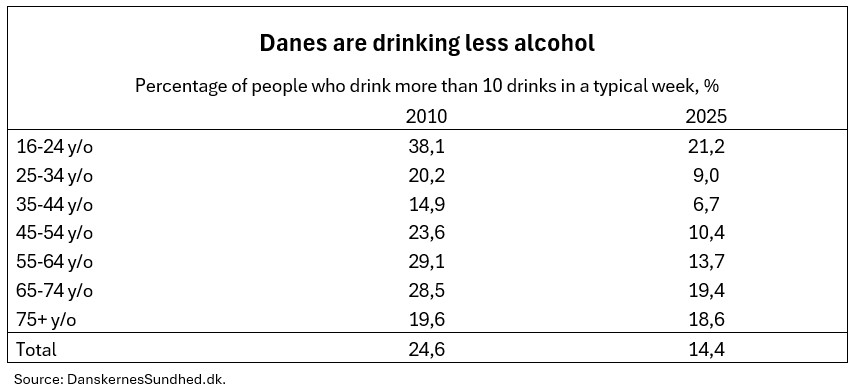
The decline is substantial across all age groups except those aged 75+. People aged 35–44 drink the least, while the youngest and oldest groups are most likely to consume more than 10 drinks per week.
Young women are not more physically active than middle-aged individuals
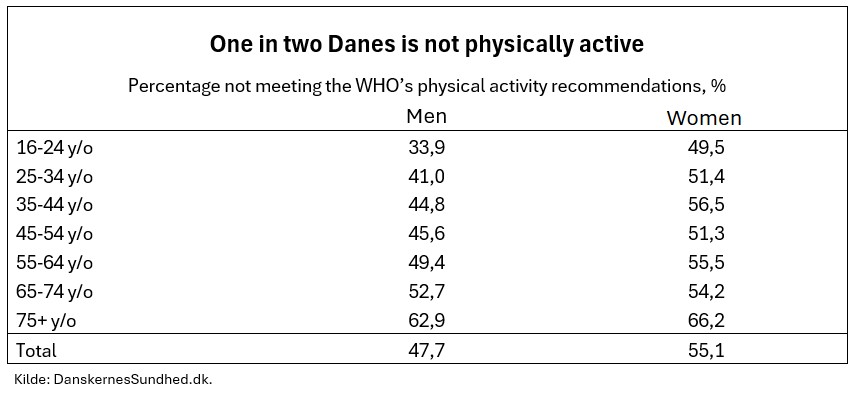
Another health behavior is physical activity. One in two Danes does not meet the recommendation of at least 150 minutes of moderate-intensity activity per week or 75 minutes of vigorous activity. The highest compliance is among young people and the lowest among older individuals. 42% of 16–24-year-olds do not meet the recommendation, compared with 65% among those aged 75+.
Table 3
Why is health important for businesses?
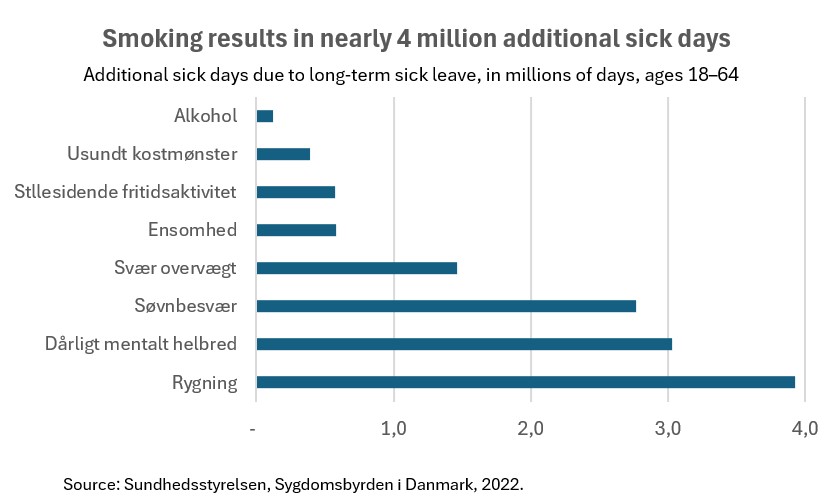
According to the Danish Health Authority, smokers and former smokers have significantly higher absenteeism than people who have never smoked. Together, smokers and former smokers account for nearly 4 million additional sick days compared with never-smokers. This represents a major cost for businesses. Assuming that 3 out of 4 people aged 18–64 are employed, and that a sick day costs a company DKK 2,220 (DKK 300 per hour), nearly 4 million sick days cost businesses DKK 6.5 billion.
Other health factors that lead to high absenteeism include poor mental health and sleep problems, which account for 3 million and 2.8 million additional sick days, respectively (see Figure 4).
Figure 4
Daily smoking of at least 15 cigarettes reduces life expectancy by 9.3 years.
As the number of smokers has declined (see Figure 3), business costs have also decreased.
If one hour of sick leave costs businesses DKK 300, and that 3 out of 4 people aged 18–64 is employed, the additional sick days (see Figure 4) result in annual costs for businesses of over DKK 20 billion. In addition, there are fewer people in employment due to premature death.
Employees’ health behaviors therefore have a significant impact on business costs. At the same time, most companies are concerned with ensuring that their employees have a good quality of life and that society is not unnecessarily burdened by high costs due to poor health.
Littler comments
Employment has increased significantly over a long period. Improved health behaviors in the population could provide the basis for even more people entering the workforce. Better health in areas such as smoking, sleep, and mental well-being can also substantially reduce business costs related to absenteeism.
If you need advice on issues such as sick leave or sickness benefits, please contact us here.
Disclaimer: This article is not and cannot replace legal advice.
Erik Simonsen
Senior Director
+45 44 14 30 96
