Shortage of Employees - Most Severe in Iron, Metal, and Automotive Trades
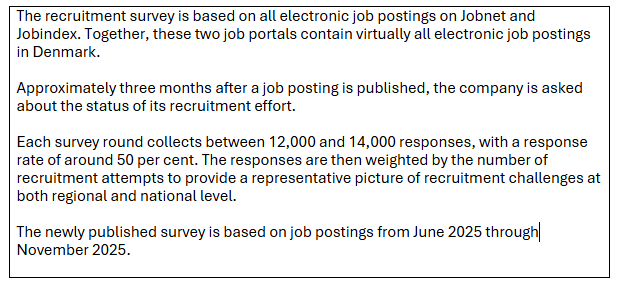
The Danish Agency for Labour Market and Recruitment (STAR) conducts a quarterly survey mapping companies’ recruitment efforts. The latest survey, covering the period from June 2025 through November 2025, has just been published.
In 10.5 per cent of recruitment attempts, it was not possible to fill the vacancy. This corresponds to 46,800 job postings that remained unfilled. In a further 13 per cent of cases - equivalent to 58,000 recruitment attempts - the position was filled by a candidate who did not have the desired qualifications. Overall, Danish companies face difficulties finding the desired candidates in nearly one out of four recruitment attempts.
Recruitment Is Most Difficult in “Iron, Metal, and Automotive” and Construction
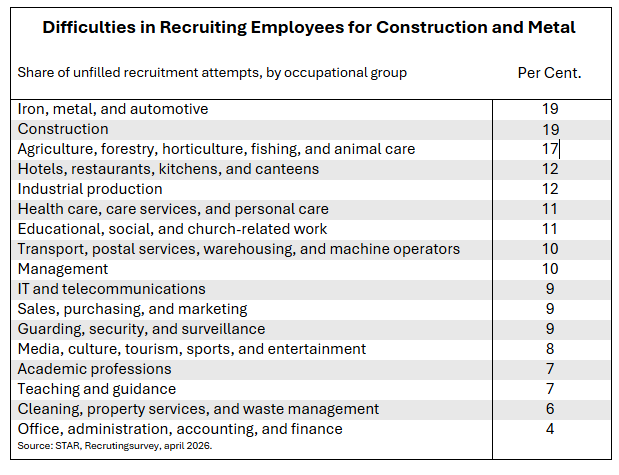
The average of 10.5 per cent of job postings that are never filled varies considerably across occupational groups. Recruitment is most challenging within “iron, metal, and automotive” and “construction”, where 19 per cent of job postings remain unfilled. Recruitment is easiest within “office, administration, accounting, and finance”, where only 4 per cent of job postings are not filled (see Table 1).
Table 1
Electrician Vacancies Are Lost Most Frequently
The most severe labour shortages are found in occupational groups with many skilled and unskilled workers. Jobs in these groups are often physically demanding.
By contrast, recruitment is generally easier for employees with academic backgrounds, for example in marketing, media, culture, education, and administration.
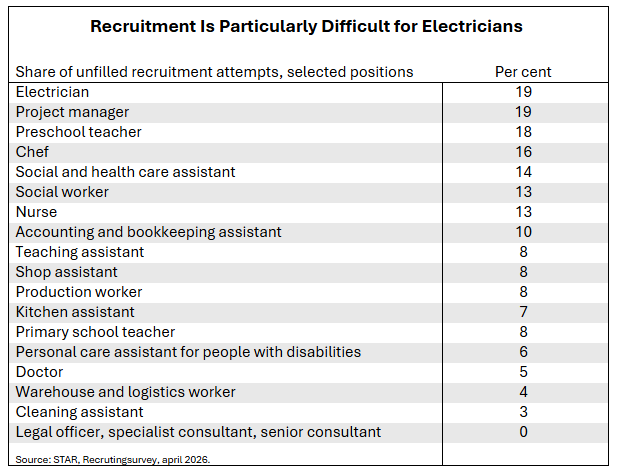
Electrician and project manager are the job titles for which vacancies most frequently go unfilled because it is not possible to find a suitable candidate (see Table 2).
Table 2
Box 1

Willingness and Ability to Recruit Candidates with a Different Profile
Tables 1 and 2 only show cases where positions could not be filled at all. Companies typically aim to hire candidates who match the requirements stated in the job posting. If such candidates cannot be found, a company can either conclude that recruitment has failed or choose to compromise by hiring a candidate without all the desired qualifications. On average, companies take this latter approach in 13 per cent of all recruitment attempts.
For some positions, substitution is either not possible or not desirable. This may apply, for example, to docters or nurses, where it can be difficult to compromise on formal education or professional competences.
Hiring candidates who do not fully meet the required qualifications is most common within “sales, purchasing, and marketing” (approximately 21 per cent of job postings) and “iron, metal, and automotive” (approximately 19 per cent).
For “sales, purchasing, and marketing”, this may partly explain why the share of lost jobs is relatively low at 9 per cent. In contrast, “iron, metal, and automotive” generally faces major recruitment challenges. Even though companies in this area are often willing to accept candidates with different competence profiles than desired, this occupational group still experiences the highest level of unfilled vacancies. Overall, it is the area with the greatest recruitment challenges.
Process
Littler Comments
Employment has increased significantly over a long period. Further increases in employment require that companies operate under sound framework conditions. In addition, companies must work strategically to include, recruit, and retain employees.
There is considerable uncertainty about the future for many companies. The wars in Iran and Ukraine and uncertain market conditions in the United States, for example, present major challenges for businesses. Companies’ ability to adapt and change course will continue to be of critical importance.
If you need advice on, for example:
- recruiting international employees
- including senior workers, or
- increasing or reducing your workforce
Contact us here.

Erik Simonsen
Senior Director
+45 44 14 30 96
